The Open Society and Its Enemies
For millennia, humans have constantly imagined ideal societies that are organized in radically different ways from their own: Plato’s Kallipolis, Bacon’s New Atlantis, Marx’s communist revolution, etc. We call them Utopias. The term was coined by Sir Thomas More in his 1516 book with the same name, as a Greek pun meaning both “good place” (eu topos) and “no-place” (ou topos).
Interestingly, it seems that the word “Utopia” has taken on a pejorative connotation in modern times: to say someone’s ideas are “utopian” is to say they are thinking wishfully. Many philosophers are not just critical, but completely dismissive of any Utopian imaginations. Karl Popper is perhaps the most influential out of them all. In his seminal 1945 book The Open Society and Its Enemies, he critiques Plato, Marx, and Hegel for their ‘ideal societies’ laying the groundwork for authoritarianism— a timely book, as Popper was writing while fascist and communist totalitarian governments were rolling over Europe. In this article I break down Popper’s critique, and ask the question: Are we beyond utopias? Have we finally learnt our lesson from the failed 20th century experiments for designing perfect societies? Do utopian imaginations still have a place in shaping our society today?
Popper’s critique of Utopias
The Open Society and Its Enemies is structured into two volumes: the first providing a detailed critique of Plato and The Republic, the second critiquing Hegel and Marx. It begins with a bold claim: that humanity is slowly but surely transforming from the “closed societies” of the past to “open societies”. What does this mean? Popper’s “closed societies” were fundamentally collectivist societies that focused on unity and collective growth— take Ancient Rome, or the Soviet Union. “Open societies”, on the other hand, were societies that put their focus on individual freedoms and rights— the modern liberal democracy in the west.
“Anxiety is the Dizziness of Freedom”
For Popper, the reason “closed societies” were more popular for a great chunk of human history is because there is a cost to open societies, one Popper called “The Strain of Civilization”. It’s more complicated to live in an open society: different people want vastly different things for themselves and others; people constantly change their minds about how they want society organized; people have to find their own role in society rather than being given one. But it’s worth it, Popper argued, because at least in open societies, individuals are in charge of their own lives. It’s really the same notion to Kierkegaard’s famous saying “anxiety is the dizziness of freedom”: there is always a cost to freedom, but it's always worth it to pay that cost.
All of this sets the foundation for Popper’s critique of Plato’s Republic. Popper argued that the democratic society Athens had at the time was one of humanity’s first big steps towards the open society, but Plato reacted to it in a completely wrong way. Plato did not view societies as something constantly progressing to become better, but rather as a cycle of “Golden Ages” and eventual decay. So he viewed Athenian democracy as not something to be improved on but rather a mistake, an imperfect society decayed from the original, ideal form. This is evident in the Republic, as Plato’s main mission was to create a system that sustains itself and doesn’t descend into what he thought of as “imperfect societies”, such as oligarchy, democracy, or tyranny.
To Popper, Plato’s approach popularized “holism”, the idea that improvement or change must happen on a systematic society-wide level, and “essentialism”, the idea that all individuals have set purposes in a state determined by their abilities. Popper argued these two values basically guaranteed totalitarianism, and that is evident in the Republic: a philosopher king, rigid class structures, and of course, propaganda and censorship (the “magnificent myth” and Plato’s views on art). While Plato’s Republic does give a way to make sure rulers don’t corrupt their power, the foundations of his society is based on the idea that individuals must subjugate themselves to the system for greater “collective happiness”. So even if a Platonic society is somehow able to never have tyrannic rulers, modern open societies may still be preferable at the cost of the “strain of civilization”.
I will not elaborate much on Popper’s critique of Hegel and Marx in this article, because part of it is similar to his critique of Plato, but also because it is not as relevant to our discussion on Utopias. To quickly overview, instead of focusing on “holism” and “essentialism” he critiques Hegel and Marx for their “historicism”: a linear view of history that there are certain laws of historical development just like laws of science that we can use to determine the trajectory of history; for Marx specifically that trajectory was towards a communist society. Regardless of their differences, Popper calls both Hegel/Marx’s approach and Plato’s “Utopian Social Engineering”: a mode of engineering society that aspires to come up with the perfect society, and then work towards manifesting it. Popper thinks Utopian social engineering is fundamentally flawed not only because it leads to totalitarianism, as we’ve seen above, but also because it is, as he would say, pseudoscientific.
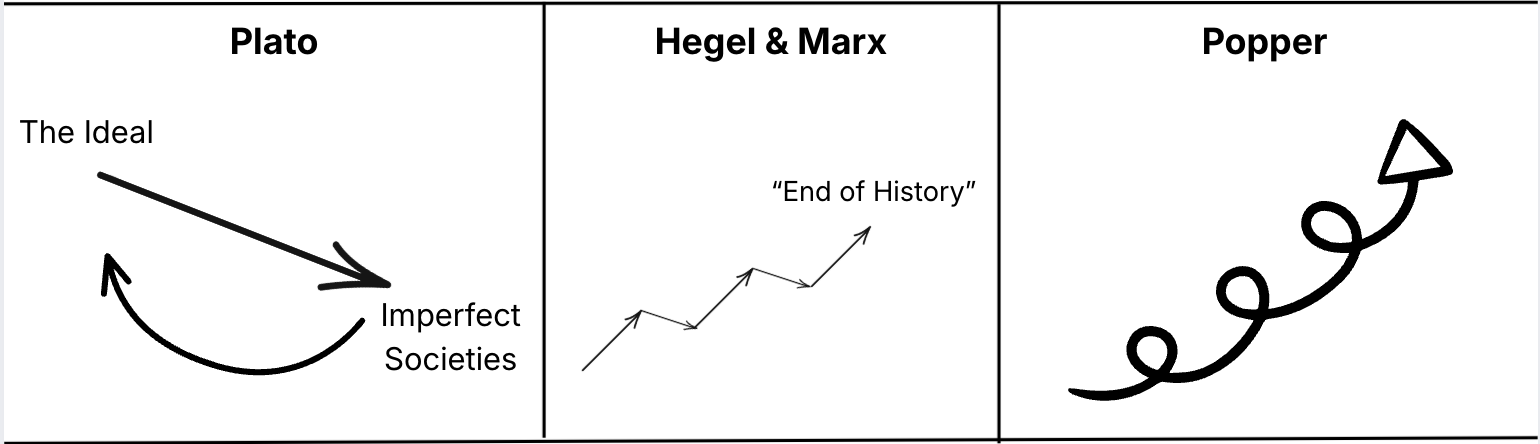
He makes an analogy to an engineer creating a machine. An engineer doesn’t design the perfect machine in his head and carry it out; he works by constantly making small adjustments to improve the machine. The scientific method is similar: the goal is not for theories to be objectively correct, but to be less wrong than the previous iteration. Popper argues this is how societies must be engineered as well: not by asserting an “objectively correct” theory and working to maintain it; that would be pseudoscientific; but by improving the open society little by little, piece by piece, in an alternative mode he called “Piecemeal Social Engineering”. If Plato’s society was cyclical and Hegel’s and Marx’s were linear, Popper’s vision for society was one spiraling outwards, constantly testing and improving policies to make society better incrementally rather than once-for-all.
In other words, Popper is saying that Plato is asking the wrong question. He asks “who should rule society so that it is stable forever?” when the better question he should be asking is: “how do we constitute a society that can automatically replace bad rulers with good ones without bloodshed?”
In the next section, I will dive deeper into Popper’s defense of the open society, a liberal democracy, and argue my point on why the open society still requires Utopian imaginations.
Are we beyond Utopias?
“Oppression involves a failure of the imagination: the failure to imagine the full humanity of other human beings.” - Margaret Atwood
To Popper, the biggest threat to the open society are communist and authoritarian governments that operate under the Utopian social engineering framework. At the time he was writing, he was right: Nazi Germany and the Soviet Union were the biggest threats to liberal democracy. But today, the greatest threat to open society does not come from outside, but from within.
The greatest enemy to open society today is not a rival, alternative ideology advocating for closed societies, but rather a decline in coherent political ideologies as a whole within democracy. The liberal democratic system we have, designed to filter bad rulers, now favors rulers who have no coherent vision and instead leverage the psychological biases of people to gain power.
TO BE CONTINUED LATER…
