Carpe Diem, but what does it really mean?
‘Carpe Diem’ may be the most popular Latin aphorism in modern culture, but it is undoubtedly the most misunderstood.
In English, ‘Carpe Diem’ is usually translated as ‘seize the day’. This translation is misleading and misrepresents what the original Latin phrase was actually supposed to mean. In this short article, I will try to unpack what carpe diem truly means in its original form.
The phrase was coined by the famous Roman poet Horace in Ode 1.11, part of a series of Odes he published in 23 BC. Here is the original poem with an English translation:
“Tu ne quaesieris (scire nefas) quem mihi, quem tibi
finem di dederint, Leuconoe, nec Babylonios
temptaris numeros. Ut melius quicquid erit pati
Seu pluris hiemes seu tribuit Iuppiter ultimam,
quae nunc oppositis debilitat pumicibus mare
Tyrrhenum, sapias, vina liques et spatio brevi
spem longam reseces. Dum loquimur, fugerit invida
aetas: carpe diem, quam minimum credula postero.”
— Horace, Ode 1.11
The ode was written from the perspective of an admirer of a young woman named Leuconoe, trying to persuade her not to fret over the unknown future, but to enjoy the present moment and be with him.
In that famous final line, Horace writes “carpe diem, quam minimum credula postero.” The verb ‘carpe’ in Latin is most used in agriculture, meaning “plucking” or “picking the fruit”. Therefore, the most literal translation would be “pluck the day”, as one would pick a ripe fruit from a tree.
The modern translation ‘seize the day’ adds a violent, aggressive urgency that the original phrase never intended. The word “seize” implies a forceful grab, taking as much as possible, whereas “plucking” suggest patience - waiting for the fruit of the day to ripen so one can savor its best parts. In this way, ‘Carpe Diem’ warns against our modern, hyper-productive, maximalist lifestyle. It should not be understood as ‘squeezing as many tasks as possible into a day, but rather to focus on quality over quantity, and pluck out of the day what is most meaningful to oneself.
Nevertheless, what the English translation gets right is the emphasis on the present rather than past regrets or future hopes. Throughout the ode, Horace highlights the futility of putting our happiness to tomorrow, given how unpredictable the future is. ‘Carpe Diem’ then serves as a positively command to live the present to its fullest.
Crucially, ‘Carpe Diem’ is not just a single quote by Horace, but a recurring theme within Horace’s odes. In Ode 2.3, Horace addresses a materialistic politician who mistakes the point of ‘Carpe Diem’ and assumes lavish spending can bring them happiness. Later, in Ode 4.7, Horace reflects on the fleeting nature of life as he describes winter transitioning into spring, with ‘Carpe Diem’ once again being a major theme.
To truly appreciate this recurring philosophy in Horace’s work, it may be useful to know a little about Horace’s life to understand how ‘Carpe Diem’ can be a synthesis of Horace’s personal journeys.
As a young man studying in Rome and Athens, he picked up the Anti-Caesarian political ideas that were popular among youth in his generation. After Ides of March 44 BC, when Julius Caesar was assassinated, Horace threw himself into the republican cause, fighting alongside Brutus and Cassius to prevent Augustus from continuing Caesar’s domination.
However, after the Republican defeat in Philippi, he decided to return to Rome, and abandon politics. He made friends with Virgil and Maecenas, who eventually gifted him a farm in the Sabine Hills just north of Rome, where he lived his later life and composed most of his famous poetry, including the Odes. Tucked away in his country house, he lived an Epicurean lifestye, prioritizing pleasures and tranquility and staying as far as he could from politics.
When we look at Horace’s journey from the battlefields of the Roman civil wars to the his quiet, Sabine farm, the centrality of carpe diem in Horace’s work makes a lot more sense, and the phrase itself also becomes clearer in meaning. It’s neither a call to hustle culture nor a passionate battle cry. Instead, it’s Horace warning us about how fragile life could be when consumed by politics and war. To "pluck the day" is not to do the most things in a day but to do the most meaningful things in a day, and to accept that the future is entirely out of our hands.
Bibliography
Beth, Cora. Review of Horace, Odes 1.11. Classical Studies Support, March 20, 2019. https://classicalstudies.support/about/the-latin-page/horace-odes-1-11/.
Ellis, Robert. “Roman Lyric Poet Horace | Research Starters | EBSCO Research.” EBSCO, 2022. https://www.ebsco.com/research-starters/history/roman-lyric-poet-horace.
Horace. Horace, the Odes. Princeton University Press, 2020.
Masson, Scott. “Horace and Classical Literary Theory.” YouTube, September 26, 2025. https://www.youtube.com/watch?v=Fz_q080CkyA.
William Scovil Anderson. Why Horace? Bolchazy-Carducci Publishers, 1999.
‘Carpe Diem’ in Dead Poets Society (1989)
“You should not ask – to know is a sin – which end
the gods have given to me, or to you, Leuconoe, nor
should you meddle with Babylonian calculations. How much better to suffer
whatever will be, whether Jupiter gives us more winters, or whether this is our last,
which now weakens the Tyrrhenian sea on the pumice stones
opposing it. Be wise, strain the wine, and cut back long hope
into a small space. While we talk, envious time will
have fled: pluck the day, trusting as little as possible to the future.”
— Horace, Ode 1.11 (translated by Cora Beth)
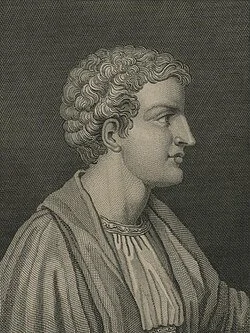
Horace (anonymous late 18th to early 19th century engraving)
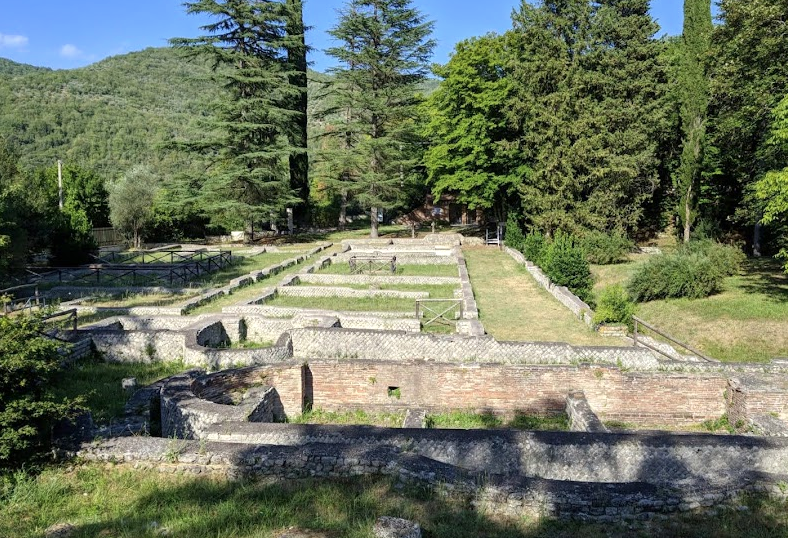
Horace’s Villa
